The naira is stranded
A transfer between two Nigerian banks clears in seconds. Speed was never the problem. The naira sits on a rail that cannot see the assets it is being exchanged for.
I’ve spent more than ten years moving money in and out of naira. Vouchers first, then crypto, now remittances. And in all that time the naira has never once been the slow part. A transfer between two Nigerian banks clears in seconds, at two in the afternoon or two in the morning, on a Sunday if you like. Dollars are the slow leg, every time. So when I hear a naira stablecoin pitched as a speed fix, I wince a little, because that gets the problem the wrong way round. The naira’s problem is that it’s stranded. It sits on a rail that can’t see any of the assets it’s being exchanged for, so anything that lives onchain has to climb off, go through the banking system, and climb back on again.
Busha is launching NGNb, a naira backed stablecoin. I’m a cofounder, so weigh what follows accordingly. I’m not going to write about the product. I want to write about the plumbing, because I’ve spent years watching it fail between banks, exchanges and payment networks, and I know what that failure costs.
Where the friction actually lives
The pattern goes like this. A business is holding value on a blockchain, usually a dollar stablecoin, and it needs to pay a supplier in Lagos who banks in naira. So it sells the stablecoin on an exchange, waits for the exchange to pay out naira, sends a bank transfer, and then somebody has to reconcile three systems that never quite agree on when the money moved.
A remittance is the same pattern with a family at the end of it. Someone in London or Toronto pays in pounds or dollars, the money crosses as a stablecoin in a matter of minutes, and then the naira still has to come off the chain and pass through a bank before anyone can spend it. Run it the other way, with a Nigerian business turning naira into dollars to pay a supplier abroad, and you hit the same gaps in reverse.
Here’s the thing. You only ever need to get bank naira onto a digital rail once. Today it happens at every step, and every step brings its own cutoff, its own counterparty and its own opinion about when the money moved. Spread that across a day’s volume and what started as an inconvenience becomes idle balances, a reconciliation queue that grows until someone has to own it full time, and a steady stream of customers asking what happened to their money.
None of this is exotic. It’s just the cost of the naira living in one world while digital assets live in another, and every business that has to straddle the two pays it.
What changes with NGNb
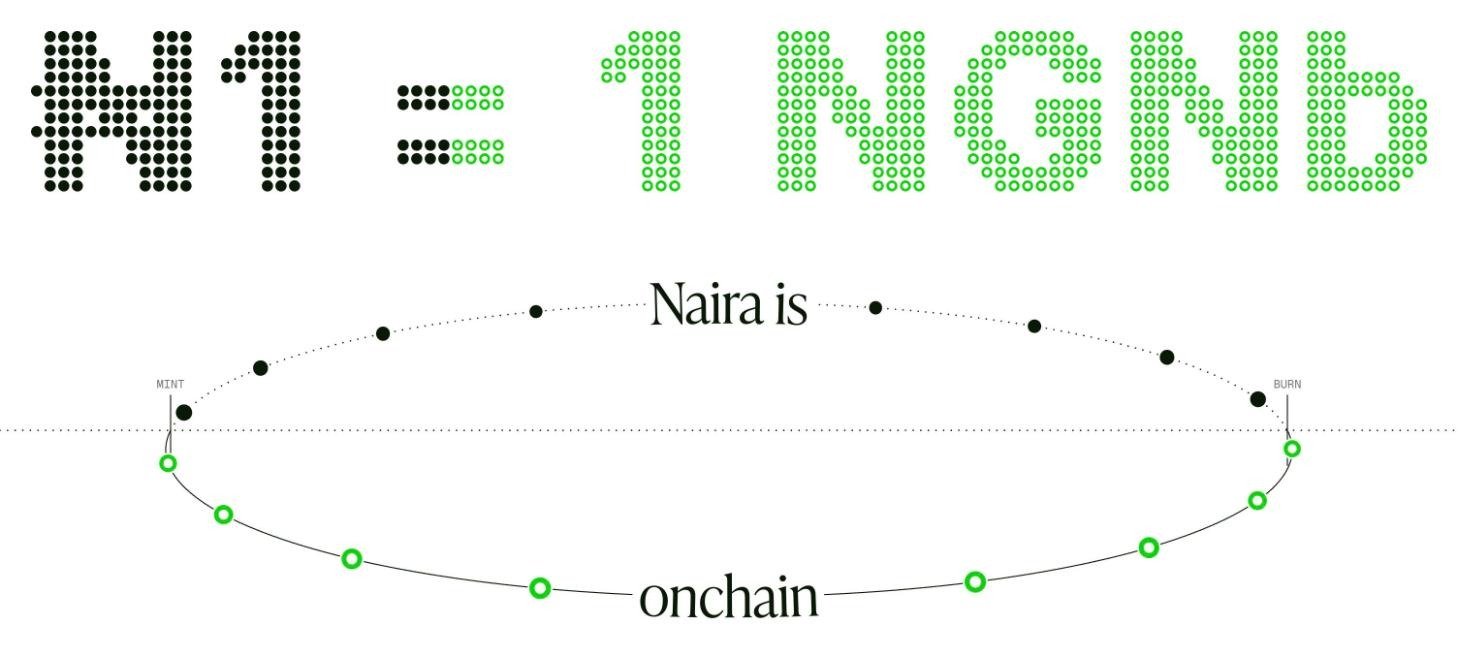
NGNb is a token that represents one naira, backed by naira held in reserve. That’s the entire idea, and it’s meant to be that plain. It isn’t something people need to understand or even notice. It’s the thing other products settle on.
What it changes is how often value has to leave the rail. That supplier payment no longer needs the sell, the payout and the bank transfer before it can settle, because the naira can stay onchain until the business actually needs it in a bank account. An exchange can list naira pairs without routing every leg through a bank. Two platforms can settle with each other on the rail they’re both already on. A fintech can treat naira the way it already treats dollar stablecoins in its payment and treasury flows. And as more traditional instruments get tokenised, there has to be a naira sitting on the same network to settle them, or the whole exercise is pointless.
Fewer forced conversions, fewer reconciliations, fewer balances parked in the wrong place waiting for someone to move them. That’s really all it is, and it’s enough.
There is already a tokenised naira
cNGN got there first, and it did the hard work of showing that a tokenised naira could exist inside Nigeria’s rules. We supported it on Busha. I’d be a hypocrite to pretend otherwise.
But I don’t think the naira needs exactly one token, any more than it needs exactly one bank. Dollar stablecoins only became useful once there were several issuers competing on reserves, on redemption, on how many places you could actually use them. That competition raised the bar for everyone and gave the people building on top a choice. The naira deserves the same depth, and a second issuer is how a market starts to look like one.
What has to be true
A stablecoin is a promise, and a promise is only worth what’s behind it. Three things have to hold, and then a fourth decides whether any of it matters. None of them are launch day claims. They get tested every single day the token exists.
The reserves have to be real naira, held properly, and visible to anyone who wants to look, because nobody should have to take our word for it. Redemption has to work every time, at par, with no excuses about liquidity or timing. And the whole thing has to sit inside Nigeria’s regulatory framework, because a naira instrument that lives outside the rules isn’t infrastructure at all. It’s a liability waiting for a bad week.
The fourth is the one I think about most. A naira token that only moves inside one exchange is a loyalty point with better branding. It becomes infrastructure when another exchange lists it and actually does volume on it, when a fintech pays people out with it instead of sending bank transfers, and when someone builds something with it that none of us saw coming. That’s why NGNb is meant to be open to anyone who wants to build on the naira, including the businesses we compete with. And you’ll be able to tell whether it’s working: a second licensed exchange doing real volume, a payments company using it for actual payouts, and a visible drop in reconciliation work and idle float for the businesses that take it up. Its value will come from how widely it’s used, not from how much of it we issue.
If NGNb works, nobody will think about it. A payment lands, a trade settles, a treasury balance reconciles, and the fact that any of it happened onchain is a detail only the engineers remember. That’s the bar I’m holding it to. Not how much gets issued, but how much friction quietly goes away from the ordinary business of moving naira around.
The details are at ngnb.co. If you run a platform that moves naira and want to talk about building on it, my contact details are on this site.